
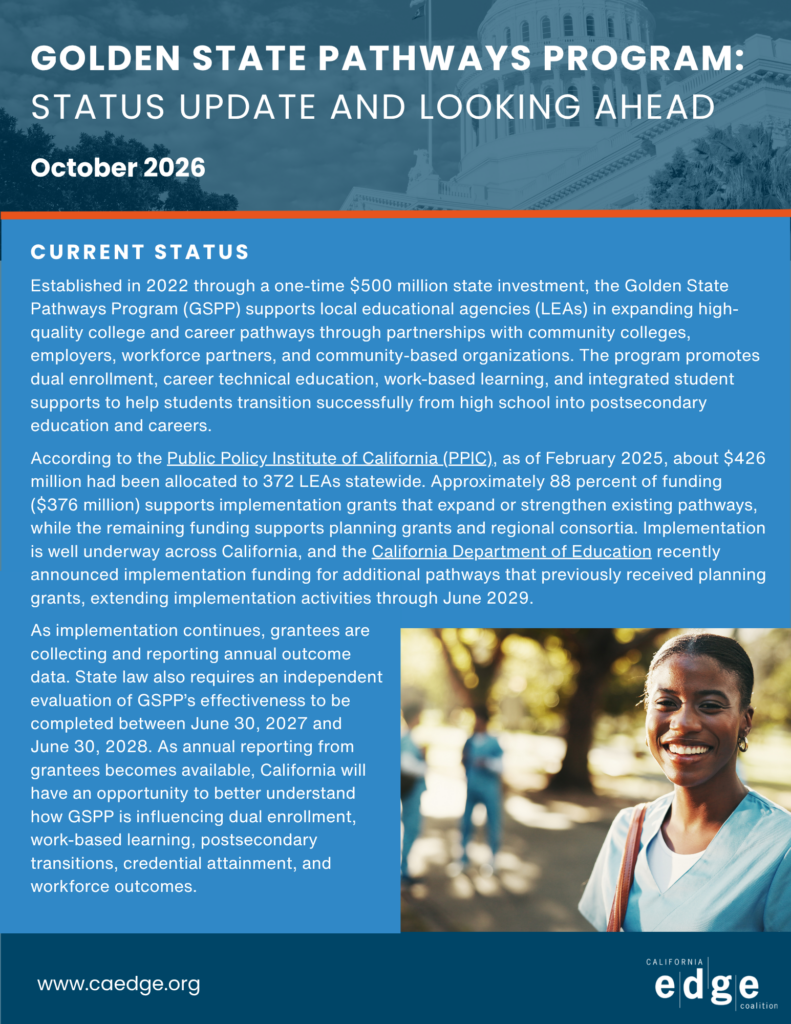
California’s Golden State Pathways Program (GSPP) represents a significant investment in building stronger connections between K–12 education, postsecondary education, and the workforce. Established in 2022 with $500 million in one-time funding, GSPP is helping communities across the state expand college

Ahead of the September 30 deadline for final action on legislation, Governor Newsom took action on bills passed by the Legislature in the second year of the 2025-26 legislative session, including several of EDGE’s priority bills. All bills that

As the Legislature returned from summer recess on August 3, the final weeks of the 2026 legislative session quickly shifted into high gear. One of the most significant milestones came on August 13, when the Assembly and Senate Appropriations Committees
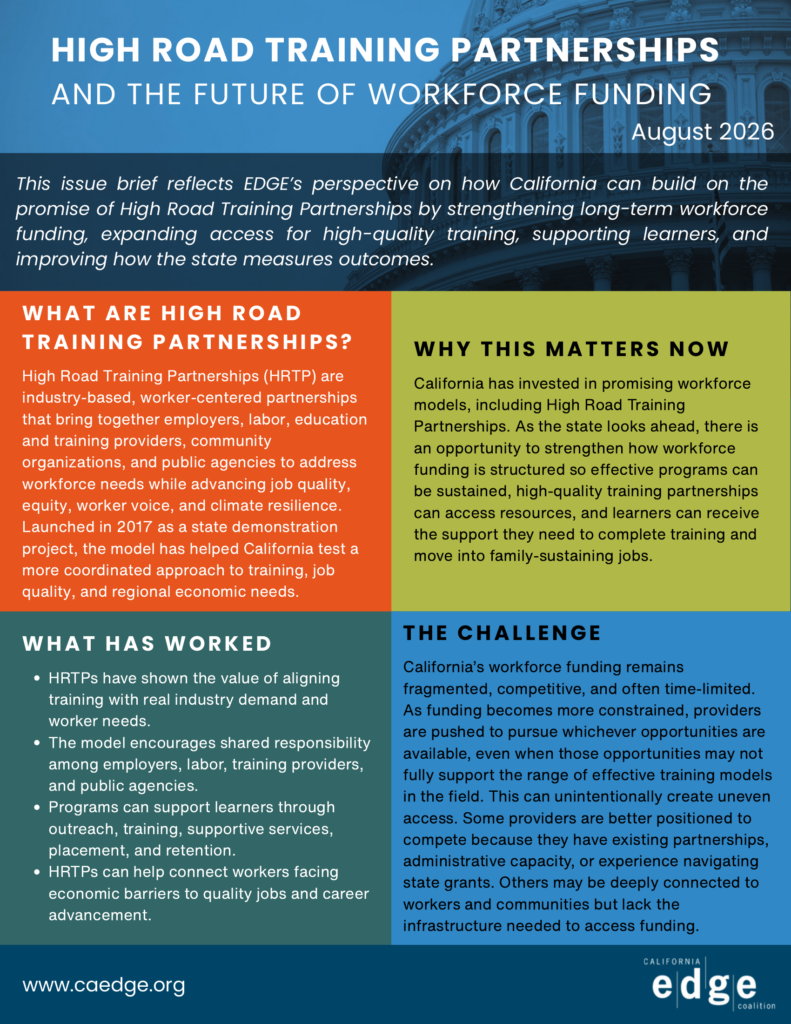
The California EDGE Coalition has released a new issue brief, High Road Training Partnerships and the Future of Workforce Funding, exploring how California can build on the progress of High Road Training Partnerships (HRTPs) while strengthening the state’s workforce funding

The Legislature kicked off its month-long summer recess on July 3rd and will be returning on August 3rd to a packed schedule ahead of the fiscal year’s final stretch. In the meantime, EDGE and our advocacy partners are hard at

On June 29, Governor Gavin Newsom signed the Budget Act of 2026-27, which outlines $351.7 billion in total state spending, including $251.5 billion from the state’s General Fund. The state enters 2026-27 with a balanced budget and no projected deficit
On June 26, 2026, the Governor and Legislature reached an agreement on the 2026–27 state budget. The agreement comes at a critical time as California works to protect safety net programs and underserved Californians from federal impacts, while also lowering

Recent federal changes under H.R. 1 have expanded work requirements for Medi-Cal and CalFresh recipients, affecting an estimated 3.5 million Californians. To maintain eligibility, many adults will now need to verify at least 20 hours of work per week for